
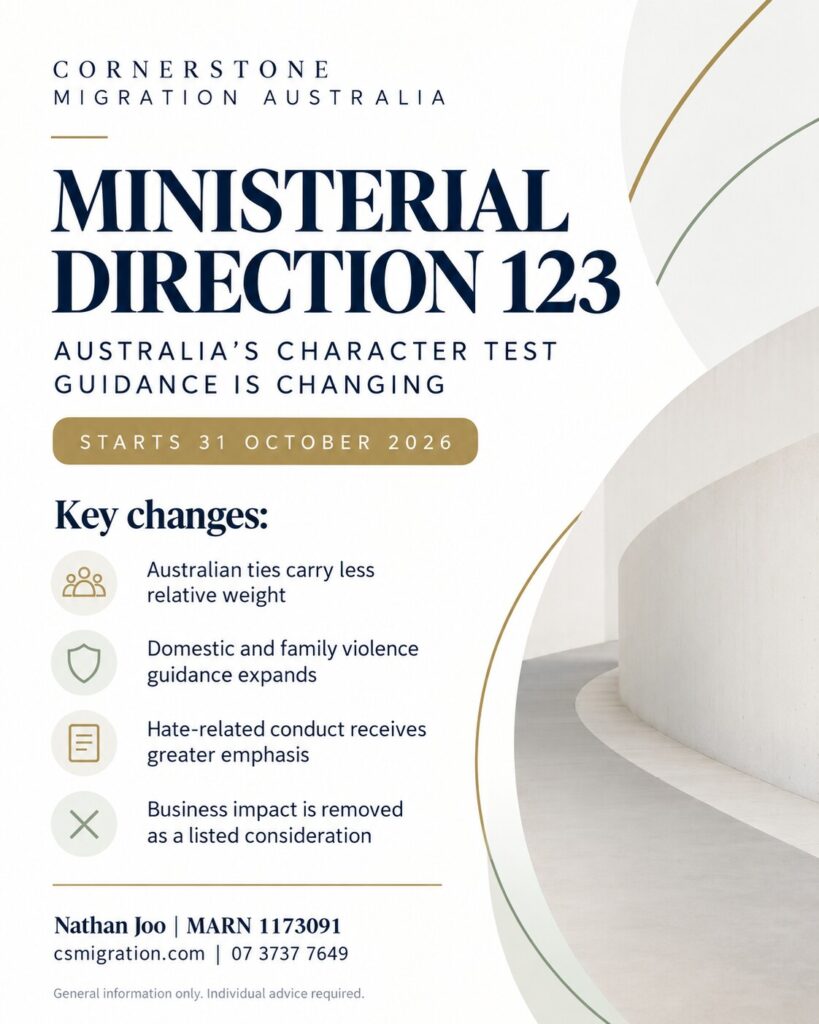
Ministerial Direction 123 will change how visa refusals, cancellations and mandatory-cancellation revocation requests are assessed under Australia’s character provisions from 31 October 2026. It replaces Ministerial Direction 110 and changes the relative weight given to several important personal and public-interest factors.
Relevant decisions: section 501 visa refusal or cancellation and section 501CA revocation decisions
Practical message: existing character submissions should be reviewed against the new framework before the Direction starts.
What is Ministerial Direction 123?
Directions made under section 499 of the Migration Act 1958 guide delegates and the Administrative Review Tribunal when they exercise powers connected with the character test. Direction 123 does not remove the need to assess each matter individually. It establishes the principles, primary considerations and other considerations that decision-makers must apply.
The new Direction was signed on 18 September 2026 and, according to the Migration Institute of Australia’s Notice 18, commences on 31 October 2026. It revokes Direction 110.
The four primary considerations
Direction 123 reduces the number of primary considerations from five to four:
- Protection of the Australian community from criminal or other serious conduct.
- Whether the conduct involved domestic or family violence.
- Expectations of the Australian community.
- The best interests of minor children in Australia, including the interests of child victims.
The most visible structural change is that the strength, nature and duration of a person’s ties to Australia moves from a primary consideration to an “other consideration”. This does not make Australian ties irrelevant, but it may reduce their relative weight when balanced against the remaining primary considerations.
Key changes that may affect character cases
Expanded domestic and family violence guidance
The definition is broader and expressly covers more forms of conduct, including image-based abuse, stalking and breaches of court orders. It also recognises a wider range of relationships, including caregiving relationships and cultural family groups. Decision-makers must consider the effects on victims and witnesses, particularly where a minor child is involved.
Greater emphasis on hate-related conduct
Hate crime conduct is added to the conduct treated very seriously. Community-expectations guidance also expressly addresses hate speech, incitement of violence or discord, and related advocacy. Annex A includes guidance for the newer character-test ground concerning specified terrorist or hate-group associations and hateful public statements.
A broader approach to sentence weight
The exclusion that previously applied to certain offence categories is removed. This means the sentence imposed may be relevant across all offence types when assessing seriousness.
Changes affecting temporary visa holders
The previous guidance concerning the duration and purpose of an intended stay and compassionate grounds for a short stay is removed. The new approach directs attention to availability for removal and the possible use of risk-based visa conditions. Community expectations may apply regardless of whether a person would remain on a temporary visa or another visa facilitating removal.
Australian business impact removed
The impact on Australian business interests is removed from the listed other considerations. Employment or business disruption will therefore no longer appear as a separate consideration capable of weighing in favour of the non-citizen under that list.
A lower future-risk formulation
Several provisions in Annex A change the formulation from a risk that a person “would” or “will” engage in relevant conduct to a risk that the person “might” engage in it. That wording change may be important in cases turning on future-risk evidence.
What should affected people do now?
- Do not rely on submissions prepared only under Direction 110. Review the structure, evidence and weighting against Direction 123.
- Document Australian ties carefully. They remain relevant, although their formal position changes.
- Address risk directly. Rehabilitation evidence, expert reports, treatment history and conduct since the relevant events may become particularly important.
- Identify effects on children and victims precisely. General statements are rarely enough; evidence should connect the facts to the relevant considerations.
- Seek individual advice early. Section 501 and 501CA matters can involve strict time limits and serious consequences.
A careful reading is essential
Direction 123 contains detailed language that cannot be reduced to a checklist. The weight given to each consideration depends on the facts, evidence and statutory task. A person with a pending character matter should obtain advice based on the full Direction and their actual circumstances.
Concerned about a character matter?
Cornerstone Migration Australia can assess how Direction 123 may affect a current or potential visa refusal, cancellation or revocation matter.
Nathan Joo | Managing Director and Principal Migration Agent
MARN 1173091
Phone: 07 3737 7649
Website: csmigration.com
Sources: Migration Institute of Australia, MIA Notice 18 dated 22 September 2026; Ministerial Direction 123 available through LEGENDcom under section 499 Directions. This article provides general information only and is not individual migration or legal advice.