
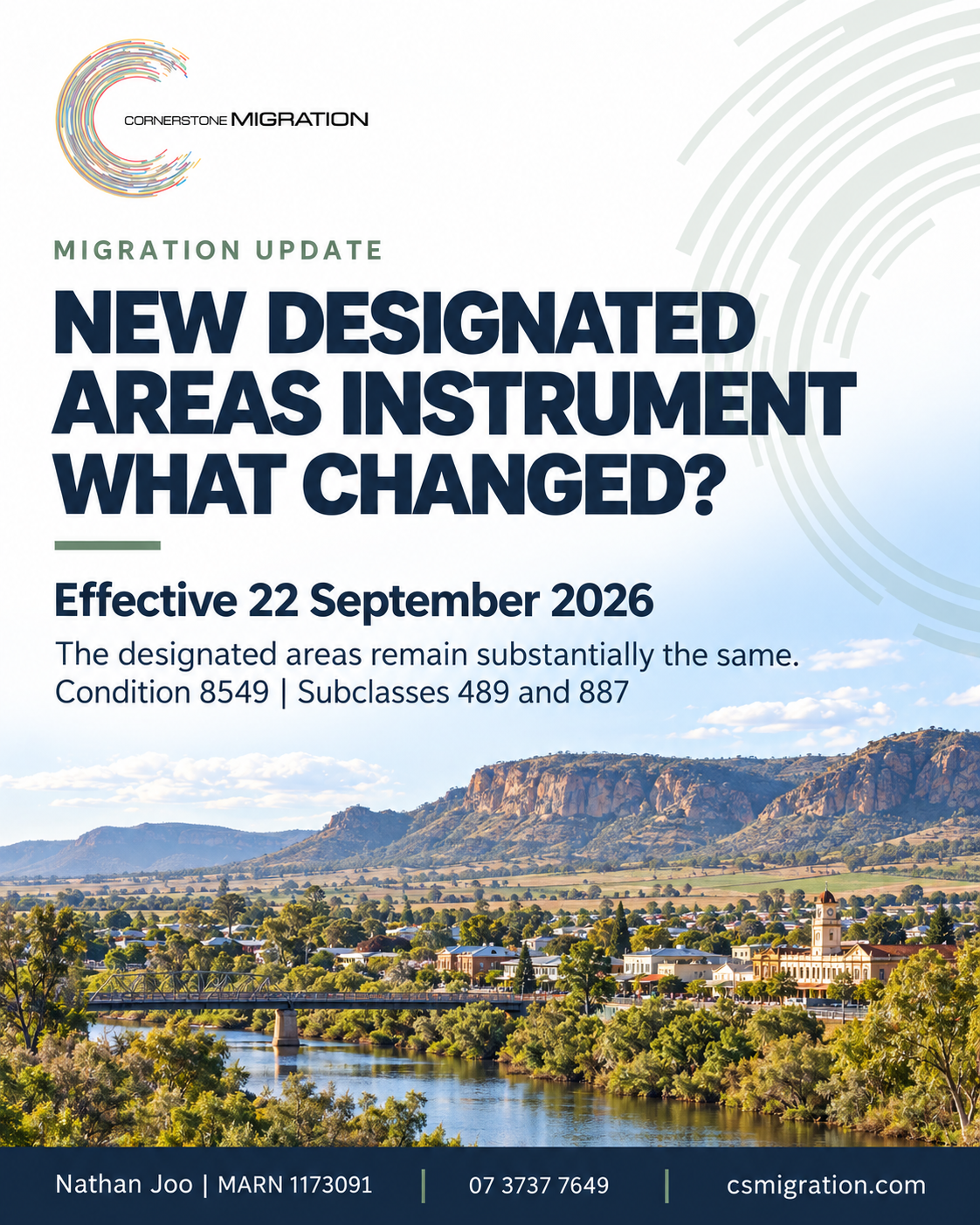
A new federal instrument has been registered for Australia’s designated migration areas. The headline is straightforward: the legal instrument is new, but the listed designated areas have been remade in substantially the same form.
What is the new instrument?
The Migration (Designated Areas) Instrument 2026 (LIN 26/004) specifies the geographical areas that count as “designated areas” under regulation 1.03 of the Migration Regulations 1994.
It repeals and replaces Designated Areas 2016/044, which was scheduled to sunset on 1 October 2026. The official explanatory statement describes the new instrument as minor or machinery in nature and says the table has been remade in substantially the same form.
Did the designated areas change?
No material geographical expansion is apparent from the new schedule. The States, Territories and postcode ranges are substantially the same as those in the repealed 2016 instrument.
Which locations remain designated?
| State or Territory | Designated area |
|---|---|
| Australian Capital Territory | Entire Territory |
| New South Wales | Specified regional postcodes, excluding Sydney, Newcastle and Wollongong |
| Norfolk Island | Entire Territory |
| Northern Territory | Entire Territory |
| Queensland | Specified postcodes outside the Brisbane metropolitan area |
| South Australia | Entire State |
| Tasmania | Entire State |
| Victoria | Entire State |
| Western Australia | Entire State |
New South Wales postcodes
2311–2312, 2328–2333, 2336–2490, 2535–2551, 2575–2739 and 2787–2898.
Queensland postcodes
4019–4028, 4037–4050, 4079–4100, 4114, 4118, 4124–4150, 4158–4168 and 4180–4899.
Who is affected?
The explanatory statement says the instrument is made in relation to visa condition 8549. That condition requires a visa holder to whom it applies to live, work and study only in a designated area.
It remains particularly relevant to certain holders of the closed Subclass 489 visa and applicants moving from a qualifying provisional visa to the Subclass 887 permanent visa. Compliance with condition 8549 can form part of the Subclass 887 assessment.
The 489 and 887 subclasses are closed to new primary applications, but existing visa holders and undecided applications can still be affected. The instrument does not reopen either subclass and does not create a new visa pathway.
What should affected visa holders check?
- Confirm whether condition 8549 appears on your visa grant notice or VEVO record.
- Check the exact postcode where you lived, worked or studied during the relevant period.
- Keep reliable residential, employment, payroll, tax and study records.
- Do not assume that a place described generally as “regional” is covered by this particular instrument.
- Obtain individual advice before relocating or lodging a Subclass 887 application if there may be a compliance gap.
What this instrument does not do
- It does not add a broad new set of designated areas.
- It does not change the points test.
- It does not change skilled visa processing priorities.
- It does not create a new DAMA or expand an existing DAMA.
- It does not guarantee eligibility for permanent residence.
This is separate from Ministerial Directions 121 and 122, which changed processing priorities for specified skilled visas from 19 September 2026.
Contact Cornerstone Migration on 07 3737 7649 for an individual assessment.
Nathan Joo
Managing Director and Principal Migration Agent
Cornerstone Migration Australia
MARN 1173091
Information checked on 21 September 2026. This article provides general information only. Visa conditions, transitional arrangements and individual circumstances must be assessed before action is taken.